

To do a Uganda safari in Queen Elizabeth National Park is like visiting a wildlife paradise living on a genuinely magnificent landscape on the floor of the rift valley. Queen Elizabeth National Park lies on the Albertine rift valley floor and watched by the bounding Rwenzori escarpments that stand beautifully in the background.
The game drive in Queen Elizabeth National Park during Uganda safari is more of a game viewing experience with a plethora of wild animals to see from the big size elephants to the small mongoose. While relaxing on a launch trip on the Kazinga channel that links Lake George to Lake Edward watch out for the wild game that congregates on the shoreline. It is an unforgettable experience with large numbers of wild animals to see. Ask For A qoutation
Several primates are living in Queen Elizabeth National Park including chimpanzees, olive baboons, vervet monkeys, grey cheeked mangabey, red tailed monkeys and more
More that 612 bird species are recorded as residents of Queen Elizabeth national Park including those on the IUCN red list. The Kazinga channel shoreline is a natural magnet for a number of birds including foreign migrants.
Brief details about Queen Elizabeth National Park in Uganda
Queen Elizabeth National Park in Uganda sits on about 1978 square kilometers of land overlooked by the Rwenzori massif which explodes from its plains. In In 1952, Queen Elizabeth National park was declared a Uganda national Park.
In terms of landscape, the Rwenzori ranges run 60 miles long and 40 miles wide in the backdrop of Queen Elizabeth National Park. From a bright light the Rwenzori massif may seem to be reachable by mere stretching out your hand.
Lake Edward borders Queen Elizabeth National Park to the west, Mitumbe Hills stretch out on the D.R.Congo side emitting a blue view in the long sight. Green escarpments mark the eastern boundary of Queen Elizabeth National Park and are marked by green escarpments of the western Rift Valley.
Tips About A Uganda Safari In Queen Elizabeth National Park
Location: In Uganda, Queen Elizabeth National park lies in Western side of Uganda on the floor of the rift valley
Altitude: Queen Elizabeth National Park rises 480 meters from 910 meters above sea level at Kazinga Channel to 1390 meters above sea level in the explosion Crater field.
Temperature: on average the temperatures of Queen Elizabeth National Park are between 18 degrees centigrade to mean maximum temperature of 28 degrees centigrade. The low altitude of Queen Elizabeth National Park and its location on the equator means temperatures are warm almost all year.
Precipitation: Average annual rainfall of Queen Elizabeth National Park is about 1250 millimeters of rain. The months of March, April, May, late October and November are the wettest.
What to Pack: On a Uganda safari to Queen Elizabeth National Park, you may cross check with the list of what to pack for Uganda tour like safari attire, safari hat, sleeveless, warmers, foldable water bottle, snacks and more.
Best time to Visit: the best time to do a Uganda safari in Queen Elizabeth National Park is the dry season which is normally June to September and December to early February. The tracks in the park are quicker to navigate in the dry season with grass lower allowing better view of the animals.
What To Do On Uganda Safari In Queen Elizabeth National Park
Game Drives in Queen Elizabeth National Park
Get up early morning or late afternoon for a game drives through the tracks distributed throughout Queen Elizabeth National Park. While driving in the park, especially the Kasenyi plain track a grass land area where several kobs and other ungulates are common in this area. There are more chances of spotting lions in action too as they prey on the ungulates.
While on game drive in Queen Elizabeth National Park, you may come across animals like lions, leopards, water bucks, bush bucks, elephants, warthogs, cape buffaloes, Uganda kobs and more.
Launch trip on Kazinga Channel
While relaxing on the 40 kilometers long boat trip, watch out for a number of wild animals that congregate on the shoreline of Kazinga channel to quench thirst or take a bath. This is the prime wildlife watching spot of Queen Elizabeth National Park. Some of the animals you may come across include lions, elephants, cape buffaloes and more. Hippos and crocodiles are common residents of Kazinga channel too.

An array of birds flocks the shores of Kazinga channel daily including Albertine rift endemics and foreign migrants that fly from as far as Europe. Some of the birds that are often spotted on the banks of Kazinga channel while on launch trip include Egyptian geese, African skimmers, pink-backed pelicans, king fisher, papyrus gonolek
Chimpanzee Trekking In Queen Elizabeth National Park
A morning or afternoon game drive in Kyambura Gorge of Queen Elizabeth National Park gets you to see chimpanzee community that reside in this area. Other primates can also be spotted in Kyambura gorge including olive baboons, black and white colobus and others.
The chimpanzees in Kyambura Gorge live in a 100 meters deep gorge which was curved by River Kyambura as it was flowing across the rift valley floor towards Kazinga channel. Two chimpanzee trekking sessions happen in Kyambura gorge that is morning and afternoon.
Birding in Queen Elizabeth National Park on Uganda Safari
Queen Elizabeth National Park has the largest number of bird species recorded in Uganda so far with more than 612 birds. The impressive list of birds in Queen Elizabeth National Park are awed to the variety of habitants where these birds are surviving.
Some of the birds likely to spot on a Uganda birding safari to Queen Elizabeth National Park include African skimmers, Shoebill Stork, Pelicans, saddle billed stork, papyrus gonolek, greater and lesser flamingos, white winged warbler, black ruped buttonquail and others.
Forest Walks In Kyambura Gorge
Take a guided walk through the forested parts of Queen Elizabeth National park including Maramagambo forest. This is a natural forest and home to several wild animals, birds, primates and much more. While walking on the trails within Maramagambo forest, you may spot several primates, birds and many others.
Enjoy the view of the blue copper lake, get to the Lake Nyamusingire where there are chances of wildlife sightings. Get to the bat cave where multitudes of bats are surviving. Watch out for several forest birds that roost in the forest daily.

Sight seeing in Queen Elizabeth National Park
While at strategic points of Queen Elizabeth National Park, you enjoy the view of the floor of the rift valley. A guided walk on the Mweya peninsular offers better view of the sightings of Queen Elizabeth National Park. While at the information center in Mweya, you enjoy the view of Katwe bay of lake Edward, rift valley settings and more.
A drive to the crater lakes area gets you to several sightings of both dry and wet craters. The crater lakes area runs 24 kilometers of lake, forest and savanna. At times flamingos may be spotted at some crater.
The Katwe salt mining area where ancient methods extracting salt area used in this highly salt concentrated water. Salt is extracted from Katwe lake from evaporation pans.
How To Get To Queen Elizabeth National Park For Uganda Safari
Two routes lead to Queen Elizabeth National Park that is the North via Fort Portal and southern route via Mbarara. Both routes can be combined can make a circuit.
The Northern route to Queen Elizabeth National Park is Kampala or Entebbe to Fort Portal to Queen Elizabeth National Park. The distance from Kampala or Entebbe to Fort Portal to Queen Elizabeth National Park is about 410 kilometers drive. Enroute you can make a stop to Kibale National Park the primate haven of Uganda or Semuliki National Park.
The southern route from Kampala to Mbarara to Queen Elizabeth National Park at a distance of 420 kilometers. Enroute you can detour to Lake Mburo National Park.
From gorilla trekking or gorilla habituation experience in Bwindi Impenetrable National Park, there some routes that can be used to connect to Queen Elizabeth National Park. Via Ishasha sector of the park, the distance to cover from Bwindi Impenetrable National park is about 64 kilometers. The distance to cover from Bwindi Impenetrable National Park to Queen Elizabeth National Park is about 160 kilometers.
Daily scheduled flights are open from Entebbe or Kajjansi airstrip to Kasese or Mweya Airstrip.
Charter flight services are open for more private transport to Queen Elizabeth National park but advance arrangements are required.
Accommodation to Book During Uganda Safari In Queen Elizabeth National Park
Queen Elizabeth National park has different categories of accommodations to choose from that is luxury, mid-range or basic.
Some of the accommodations open in Queen Elizabeth National Park include:
Mweya safari Lodge, Bush lodge, Jacana lodge, Simba safari Lodge, Katara Lodge
Before booking accommodation to use on Uganda safari, identify the inclusions and exclusions of your safari package.
What To Expect On Uganda Safari In Queen Elizabeth National Park

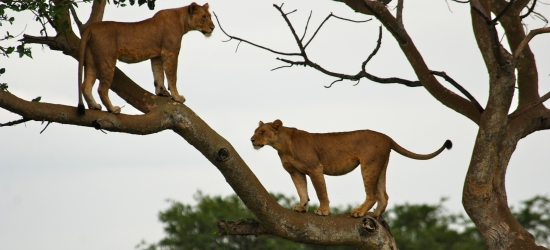
- While on Uganda safari in Queen Elizabeth National park, expect to see a variety of wild animals especially in the dry season when the grass is lower. When on a game drive in Ishasha sector of Queen Elizabeth National Park, there are chances of spotting the tree climbing lions. A tour to the marshy Edward flats offers a wildlife spectacle.
- Report to the main headquarters of Queen Elizabeth National park at Mweya Peninsular before proceeding to do a game drive in the park so that you are registered and can be followed up in case need arises.
- Expect to find other tourists during the game drive in Queen Elizabeth National Park but try to be good with each other and do not over speed as this may end in hurting some inhabitants.
- Day time is usually extremely hot because Queen Elizabeth National Park lies closer to the Equator and evenings extremely cold. Do carry some warmers for the early morning or later evening times.
- Expect some wild animals to roam the resident areas of your lodge while on safari in Queen Elizabeth National Park. Do not step out of your lodge during night time without an escorting lodge guard.
- During chimpanzee trekking in Kyambura Gorge, expect to hike to the depression where the chimpanzee community lives. Sometimes the ground in the forest is too slippery but wear suitable gears.
- In case you wish to drive off track while on game drive in Queen Elizabeth National park, seek permission from the ranger station otherwise you may hurt some animals and fall into trouble. If the wild animal is far from reach, use a pair of binoculars to catch a better sight of it.
What Is the Cost Of Uganda Safari To Queen Elizabeth National Park
The cost of Uganda safari in Queen Elizabeth National Park varies with category that is basic, mid-range and basic. The cost of park entrance to Queen Elizabeth National Park varies from $40 to $45.
Additional costs for a safari in Queen Elizabeth National Park include cost of accommodation, transport and others.
Do not forget to cost for gas or fuel to use during the game drive vehicle while in Queen Elizabeth National park. Do not forget to have full gas tank as you enter the park because access to refueling station areas are slim while inside.
Include the cost of personal expenses while putting together what you can expect to incur while on this Uganda safari for emergencies.
The number of days to spend in Queen Elizabeth National park, activities to be part of while in the park, number of people travelling with and more contribute a great deal to the cost of Uganda safari.
What To Pack For A Uganda Safari In Queen Elizabeth National Park
When packing for a Uganda safari, some of the items you must not forget include:
Safari hat
Insect repellant
Water bottle
Warmers
A torch
Safari attire
Energy bites
Light wear
Flip flops
Extra fully charged batteries
Camera
Tripod where necessary
Sun screen
Swimming costume in case your lodge has one
Extra hard cash
Water proof light bag for your shoes